Asset tracking for healthcare
Benefits
Using RFID technology has improved our care and provided a return on investment by saving us hundreds of thousands of pounds and thousands of hours of nurses’ time.
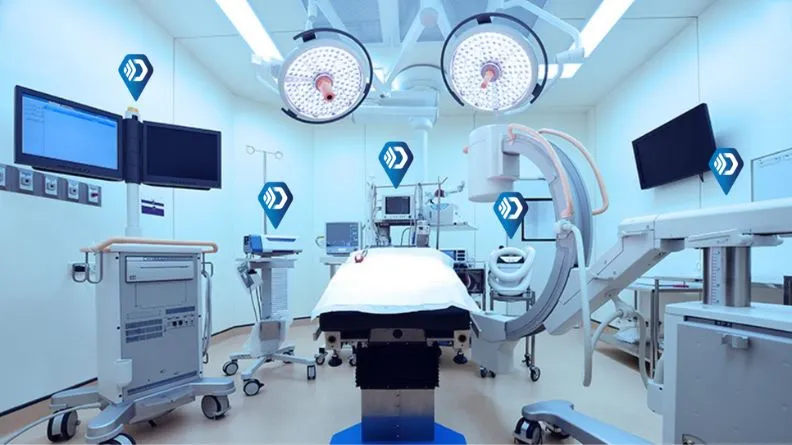
Large healthcare facilities often face significant losses and under-utilization of equipment - hundreds of mobile devices may be spread across large multi-floor hospital sites, with staff spending hours searching rather than treating patients. By enhancing visibility and control of assets, hospital operations benefit from improved efficiency, lower costs and better patient outcomes.
What is asset tracking for healthcare?
Used at numerous hospitals and other healthcare organisations throughout the UK and beyond, RFiD Discovery provides an affordable and scalable asset tracking solution that enables users to improve the management of healthcare assets.
The system provides visibility of the locations of medical devices and other assets including infusion pumps, syringe drivers, feeding devices, scanners, monitors, wheelchairs, mattresses, beds, IT equipment and communication devices. This helps to cut down on time spent locating equipment and helps to improve utilization to reduce capital expenditure.
The system has been a great time saver. We used to spend as much time looking for equipment as we did servicing it.
Over 200 hospitals in the UK use our solutions, including:






Find out how Plymouth NHS tracks 40,000 medical devices
Case study about the UK's largest GS1 compliant RFID system in healthcare
How does asset tracking work?

BLE Tracking
For accurate location tracking with RFiD Discovery, each high-value medical device is fitted with a BLE tag which transmits its unique ID at pre-set intervals.
Passive RFID tracking
In addition, passive RFID tags with GS1 compliant barcodes (where required) are used to keep an inventory of all medical assets, including lower value items. This provides an asset identification system that supports the implementation of the U.S. FDA Unique Device Identification (UDI) Rule. RFID Discovery passive tags can replace standard asset labels.
Location data
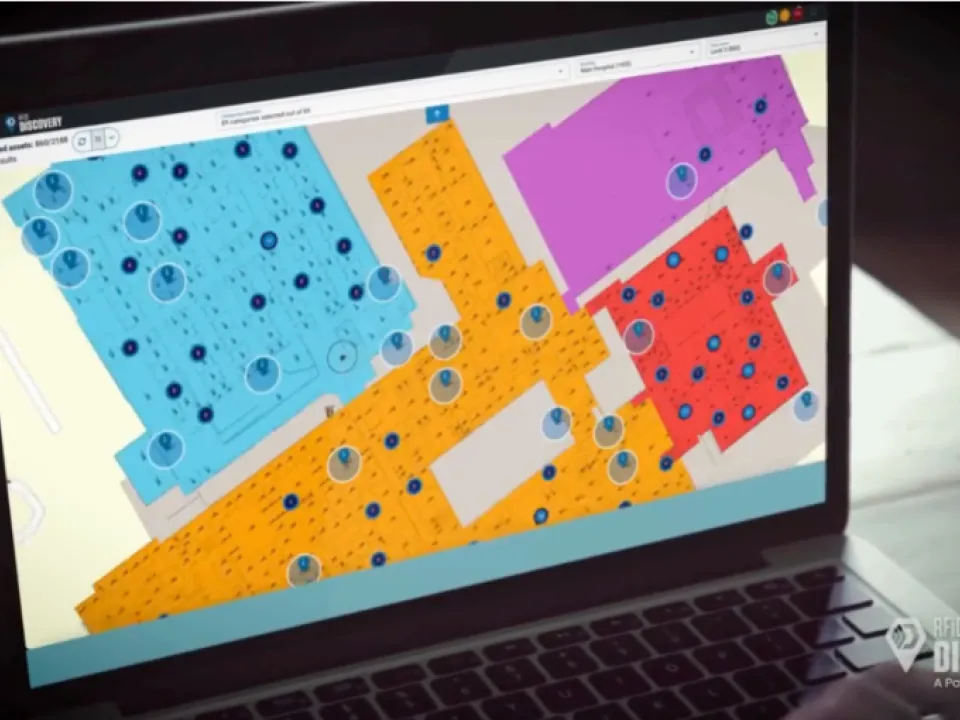
Signals from BLE and passive RFID tags are picked up either by a network of fixed readers, mobile readers or both. Mobile readers can be either a hand-held PDA system fitted with a radio frequency (RF) reader or the specially equipped RFID Discovery cart.
Find out how to track medical devices in real-time, and see locations on a map of your hospital.
Download brochure
Frequently Asked Questions (FAQs)
What is the difference between asset tracking and inventory management?
Asset tracking focuses on monitoring the real-time location and movement of hospital equipment such as infusion pumps, wheelchairs, and monitors - often using RFID or Bluetooth Low Energy (BLE) tags.
Inventory management, on the other hand, ensures accurate stock control of consumables and supplies like PPE, syringes, and dressings.
Together, they help hospitals maintain visibility of both high-value medical devices and day-to-day clinical supplies.
What is the difference between passive RFID and active RFID?
Passive RFID tags have no internal power source and are activated only when they come close to an RFID reader. Because they rely on the reader’s energy, they are small, inexpensive and ideal for applications such as inventory checks, asset identification and tracking items at short range.
Active RFID tags contain their own battery, allowing them to transmit signals continuously or at set intervals. This enables real-time location tracking over much longer distances and through more complex environments. Active tags are typically used for high-value or mobile assets where knowing the asset’s live location is essential.
How scalable is the solution? Can it be expanded across multiple sites?
RFiD Discovery's solutions can be scaled depending on individual hospital requirements. Additional readers and RFID tags can be added as necessary.
Can the system integrate with our existing infrastructure?
Yes. RFiD Discovery’s platform is designed to integrate smoothly with your existing systems and infrastructure, including asset management, maintenance and IT systems, allowing you to enhance tracking capabilities without major changes to your current setup.
Does the system comply with relevant healthcare labelling and regulatory standards?
RFiD Discovery's passive RFID labels are fully compliant with GS1 standards, carrying a Global Individual Asset Identifier (GIAI). They are encoded with a unique ID which is linked to a particular asset in the database on registration.
The RFiD Discovery GS1 Asset Labelling solution supports the implementation of the U.S. FDA Unique Device Identification (UDI) Rule, enabling healthcare providers as well as manufacturers and distributors of medical devices to automate and speed up the data capture process for medical device information.